Нова українська школа: методика навчання англійської мови у 3-4 класах закладів загальної середньої освіти на засадах компетентнісного підходу - Крістіна Карпюк 2020
Grammar Activities
Appendix
One of the most challenging but at the same time interesting spheres of English is its grammar. As you may have noticed, many previous activities presented in this book already train some grammatical structures, like Present Simple and Past Simple, the modal verb ’can’, etc.
Being explained and practised well, grammar can become not as complex as many people consider it to be. One of the keys to success is to understand the language’s logics. Good explanation and practice of grammar lead to its understanding which, in turn, leads to its successful usage in life.
1 Tests
These are one of the most widely used activities to practise or check students’ grammar.
A.
This particular test is made to practise the difference between Present, Past and Future Simple:
1 provide each student with the test presented below;
2 let the students do the test on their own;
3 let the students exchange and compare their answers with the students sitting next to them;
4 check the students’ answers and analyse their mistakes.
Choose the correct answer.
I. We ______ sports every day.
a) play b) played c) will play
II. Dave ______ Sue last week.
a) meet b) met c) will meet
III. They ______ to Brazil two years ago.
a) go b) went c) will go
IV. Jane and Sam ______ to me tomorrow.
a) come b) came c) will come
V. She ______ Maths on Mondays.
a) has b) had c) will have
VI. I ______ you next week.
a) call b) called c) will call
Answers: I - a); II - b); III - b); IV - с); V - a); VI - c).
B.
This test helps students to practise the difference between Present Simple and Present Continuous:
1 let the students put the verbs in the brackets into the correct form (Present Simple or Present Continuous);
2 check and analyse their answers.
I. I ______ (like) fish and chips.
II. Meg ______ (watch) TV every evening.
III. They ______ (play) football right now.
IV. Bob and Bill ______ (go) to the gym every weekend.
V. He ______ (wash) his hair at the moment.
VI. I ______ (do) my homework now.
Answers: I - like; II - watches; III - are playing; IV - go; V - is washing; VI - am doing.
2 Activity «Your Own Sentences»
1 make a few cards with 3 verbs on them;
2 pick up one card and write Present, Past and Future Simple sentences with one of the verbs on it as an example for the students;
3 let the students write down their own sentences, following your example;
4 let students compare their sentences with each other’s;
5 ask a few students to read their sentences aloud (check and correct them, if needed).
For example:
Card 1 (2-3 copies) —

Teacher’s sentences -
I dance every evening.
My friends danced yesterday.
We will dance tomorrow.
Card 2 (2-3 copies) —

Card 3 (2-3 copies) —

3 Game «What Am I Doing?»
This game helps students to practise Present Continuous in speaking:
1 ask students, «What am I doing?» and perform an action in front of the class (for example, jump);
2 let students answer, «You’re jumping!»;
3 let each student in turn ask «What am I doing?» and perform an action in front of everyone, accordingly (the actions should not be repeated) and the rest of the class should name it, using the Present Continuous form.
4 Using Tables
This activity helps students to learn the plural forms of regular and irregular nouns.
1 stick a sheet of paper with a table to the board and a list of nouns under it, as in the example;
2 let students put the nouns into the columns of the table according to their plural forms (but do the first one with the students, as an example for them);
3 check their answers;
4 ask students to name other nouns and put them into the appropriate columns.
|
-s |
-es |
-ies |
irregular |
List:
Student, man, lady, fox, foot, friend, city, shirt, tomato, mouse, bus, story.
5 Using Pictures
A.
This activity helps students to learn articles ’a’ and ’an’.
1 show students some pictures of objects on the board, such as below (under the pictures there should be lines for writing);
2 fill out the lines under the first two pictures as an example;
3 let students fill out the rest.
You can let students fill out the lines by coming to the board in turn or let them do the activity on their own and then check.
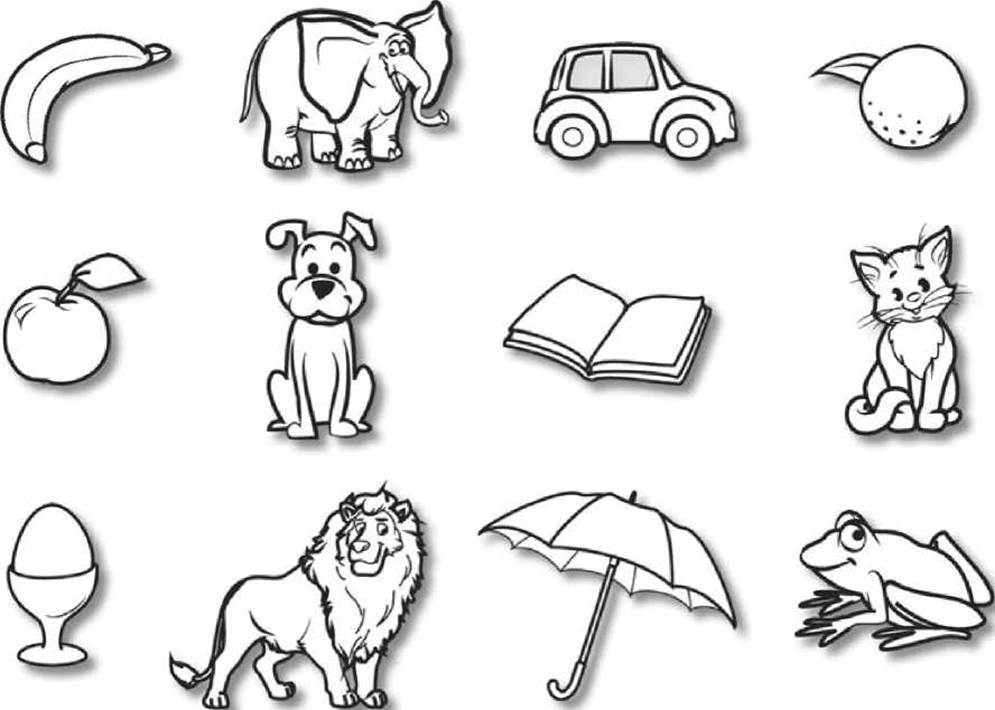
(idea taken from Evans, 2002)
B.
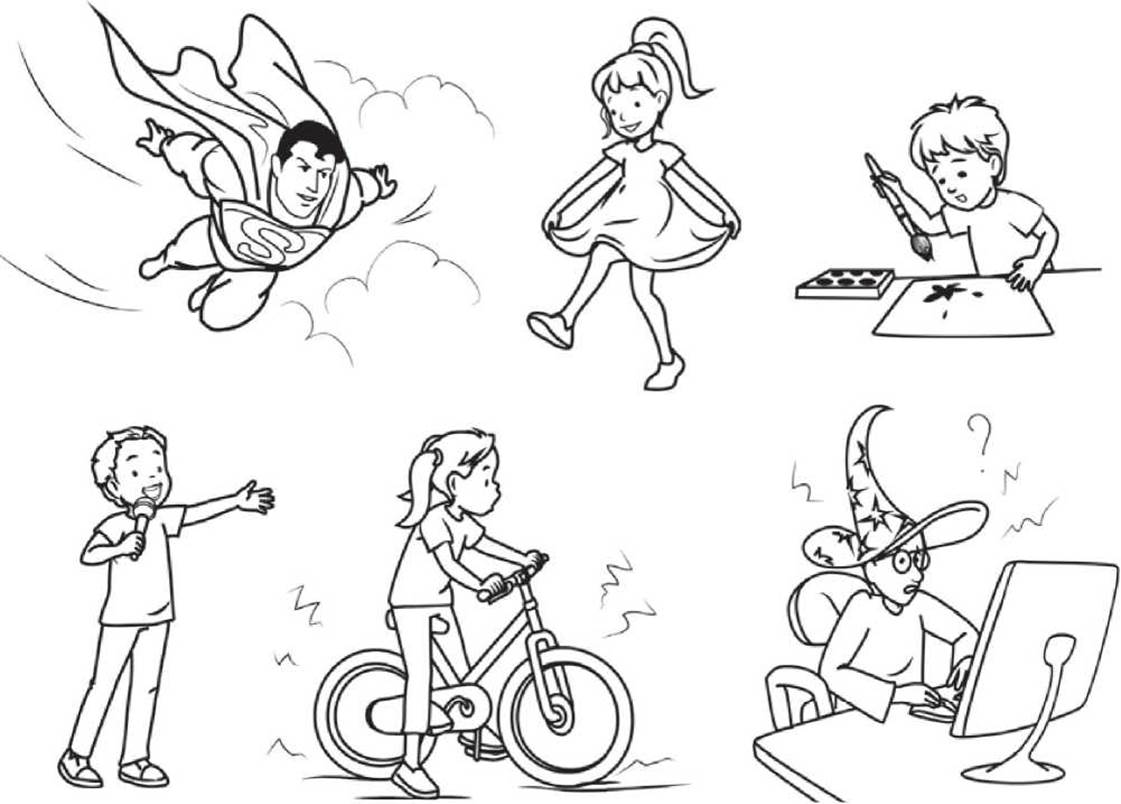
This activity trains the use of modal verbs ’can’ and ’can’t’:
1 show students some pictures of people in action on the board, such as below;
2 give each student a sheet of paper with names of people and their actions, as in the example below;
3 match the first person to their action and then make a can/can’t sentence as an example for the students;
4 let students do the rest of the activity on their own;
5 check their answers;
6 ask students what they can or can’t do.
|
1. |
A superman |
ride a bike |
|
|
2. |
Ben |
use a computer |
|
|
3. |
Sarah |
CAN |
draw |
|
4. |
Tom |
CAN’T |
fly |
|
5. |
Lilly |
dance |
|
|
6. |
A magician |
sing |
Teacher: «A superman can fly.’’
C.
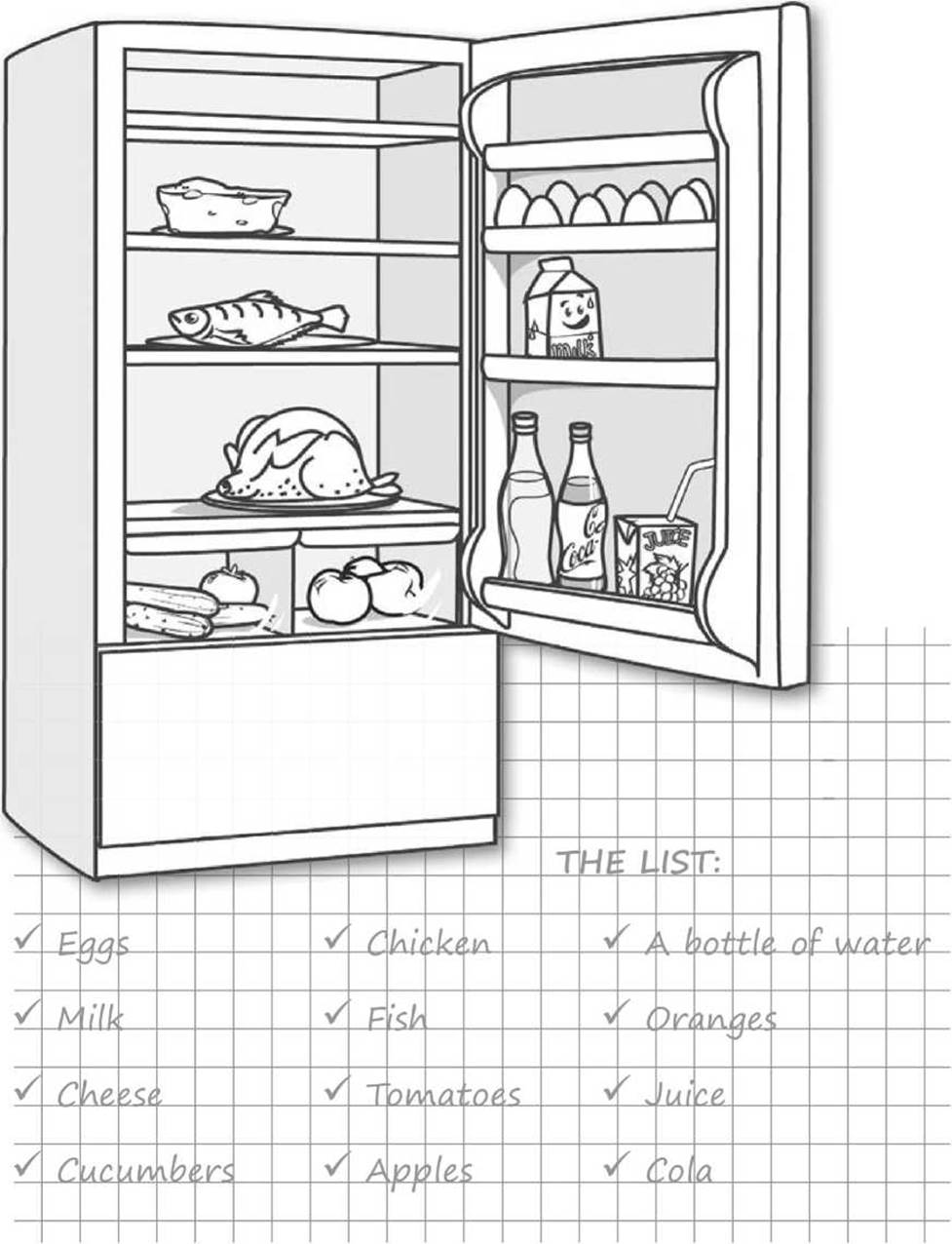
This activity trains the use of ’some’ and ’any’ as well as constructions ’there is/are’.
1 show the students a picture of an opened fridge;
2 write down a list of different products;
3 ask students what there is in the fridge;
4 let students in turn say what there is and isn’t, using the names of the products on the list.
6 Finish the Story
1 put the students in pairs;
2 give each pair the story with the picture presented below;
3 let students fill out the story with the missing prepositions of time and place from the box;
4 check their answers;
5 let each pair write the last 3-5 sentences to finish up the story;
6 let the pairs exchange and compare their stories with each other’s;
7 ask 2-3 pairs to read their stories aloud.
under, in (2), inside, on, at (2), to
Sally and Bill are _____ the park. They are walking _____ a tall tree. There are some birds _____ it. They are looking _____ them. Sally becomes thirsty and Bill - hungry. They go _____ a café. _____ it, there are a lot of tables with flowers _____ them. But there is only one waiter _____ the bar.
Answers: in, under, in, at, to, Inside, on, at.
Explain to children (or show a picture) that a bar in this case is a long table with drinks and a menu.
7 Guess the Question
This activity is made to train wh-questions:
1 put the students into two teams;
2 give each team cards with answers in a box;
3 let each student from the team pick up a card but not show it to anyone;
4 the students in that same team ask their mate some wh-questions until they ask the one which fits the answer on the card;
5 two teams do the activity at the same time while you walk around and note their questions;
6 the teams which successfully finishes the task first is the winner.
Cards:
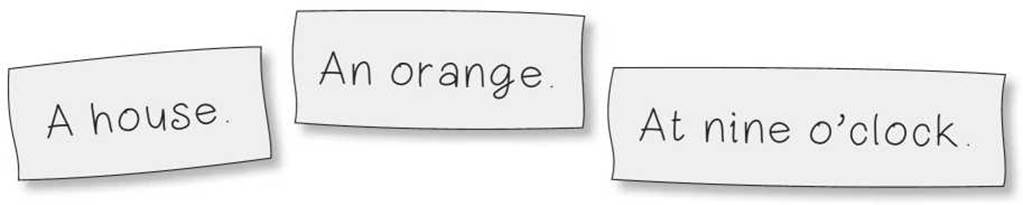
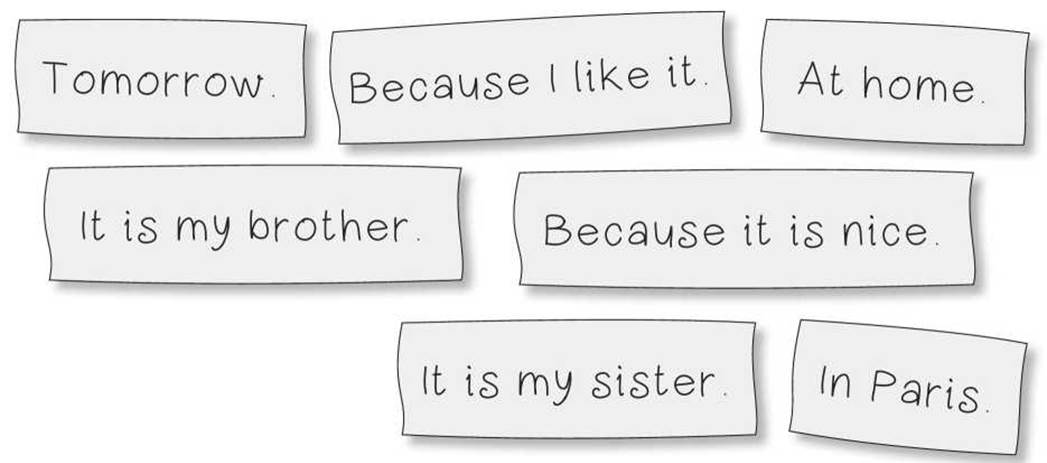
Possible questions:
✵ What is it? I What’s this?
✵ When?
✵ Why?
✵ Where?
✵ Who is it? I Who’s this?
8 Game «Higher or Lower?»
This game helps students to remind numbers and practise comparatives. You will need three dice, a shaker and a scoreboard for each group in this activity:
1 demonstrate the game to all students;
2 put the students into groups of 4-6;
3 student 1 rolls the three dice and adds up the points, saying, for instance, «I have 14.» He/she then passes the dice and the shaker to student 2;
4 student 2 guesses whether he/she will roll a lower or a higher number, saying, «Lower!» or «Higher!» and rolling the dice;
5 if student’s 2 guess is correct, he/she says, for example, «I have 13! 13 is lower than 14!» and gets a point on the scoreboard. If his/ her guess is incorrect, another student can say, «You have 17! 17 is higher than 14!» and scores a point;
6 all students take turns to guess whether he/she will get a lower/ higher number than the previously rolled one;
7 after a prearranged number of rounds, add the points up and the student with the most wins the game.
(suggested by Lewis and Bedson, 2018)
9 Game «Animals»
This activity helps students to practise describing other objects as well as to learn the degrees of comparison:
1 divide the students into groups;
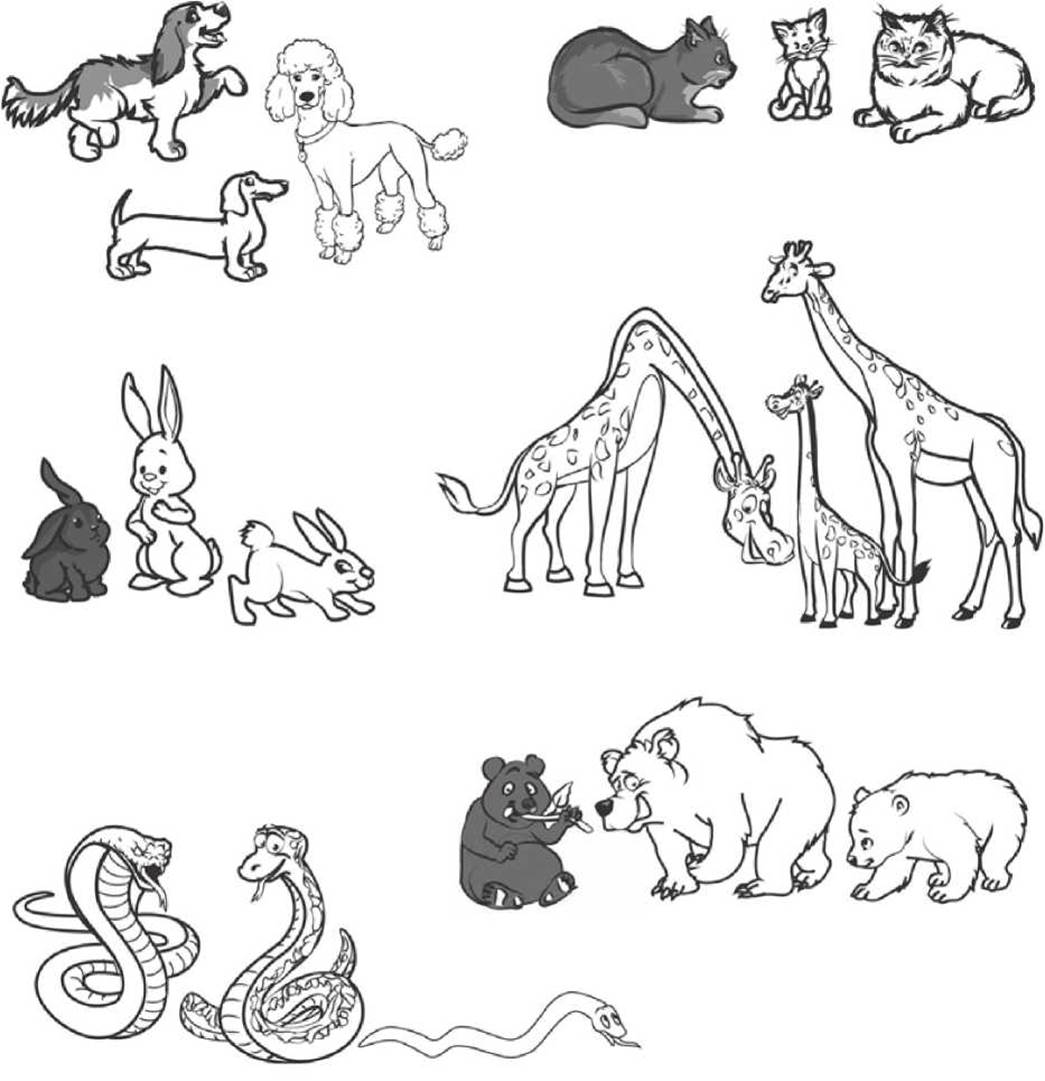
2 provide each group with three pictures of the same animal but with a different appearance, as in the example below;
3 let the students compare the animals in the pictures by saying, for instance, «This dog is brown. It is bigger than that one» (do the first three pictures with the whole class to set an example for them);
4 walk around the class and listen to the students;
5 in the end, ask students which animal they like the most and why.
10 Activity «The Weather»
This task helps students to learn impersonal sentences and practise using ’can/can’t’:
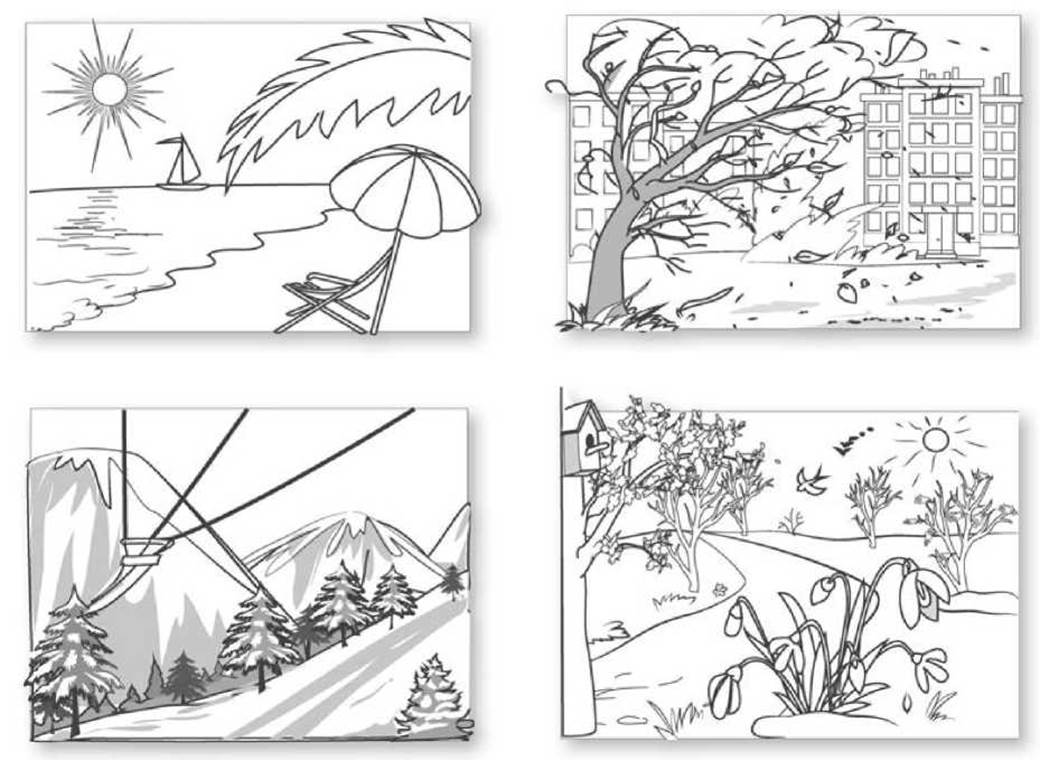
1 show students some pictures of different kinds of weather in different places, as in the example below;
2 ask the students to name the weather in the first picture («It is sunny and hot»);
3 ask them what they can and can’t do in such weather (e.g., «We can go for a walk, lie in the sun, swim, dive, etc);
4 let the students do the rest of the activity on their own and write down their answers;
5 check the students’ answers and write them on the board under or next to each picture (the kind of weather and possible activities).