Нова українська школа: методика навчання англійської мови у 3-4 класах закладів загальної середньої освіти на засадах компетентнісного підходу - Крістіна Карпюк 2020
Speaking and pronunciation Activities
Appendix
Since language is, first of all, a means of communication, it is necessary for the students to be able to express themselves orally - not only using the right words and grammar constructions, but pronouncing everything well, too. Remember: your lessons may be the only time when your students can hear and speak English. That is why it is so important to create a natural language environment, avoiding translation and using the children’s natural ability to learn a foreign language (acquisition). That way they will become fluent users of English.
1 Teacher-Student Talking
This classic and usually most-often used activity involves a teacher who speaks to his/her students or vice versa. Such talks, as a rule, happen randomly: you may ask your learners to speak about themselves or to express their ideas to you after doing a listening/reading task or your students may ask you to give clearer explanations, or tell something interesting about yourself, for example.
2 Mini-Dialogues
This is another classic speaking activity. By letting your students speak in pairs, you can save more time and provide everyone with an opportunity to speak English. Dialogues can be planned as well as unplanned. The second type, obviously, happens randomly, whereas in the first one you can:
1 Give your students an example of a dialogue.
2 Tell them to create and act out similar dialogues.
3 Walk around the classroom and check how everyone is doing.
3 Discussions
After listening to an audio, reading a text or watching a video, discuss it with your students or let them discuss it with each other and then present their ideas to the whole class.
4 Drama Activities
These are usually similar to the previous type (discussions). However, they can also be done in groups. Instead of giving an example in a book, you can:
1 Divide your students into pairs/groups, depending on how many characters there are.
2 Give each pair/group some cards with separate sentences on them.
3 Let students put those cards in the correct order to create a dialogue.
4 Check whether everything is correct and give the students their roles.
5 Let students act out their dialogues while you walk among them and check how they are doing.
6 Ask a few pairs/groups to act out their dialogues in front of the whole class.
OR
1 Divide the class into pairs/groups.
2 Write on the board some words/phrases on a particular topic.
3 Let students create and then act out their own dialogues, using the lexis given on the board.
OR
1 Divide your students into groups of 2-3.
2 Choose a waiter in each group.
3 Give each group a menu.
4 Let students act out dialogues on the topic «In a cafe».
5 Walk around and check how everyone is doing.
5 Storytelling
1 Divide your students into groups of 3-4.
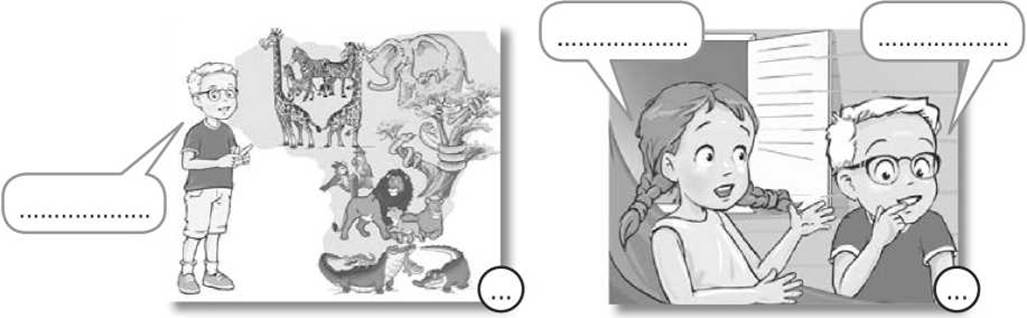
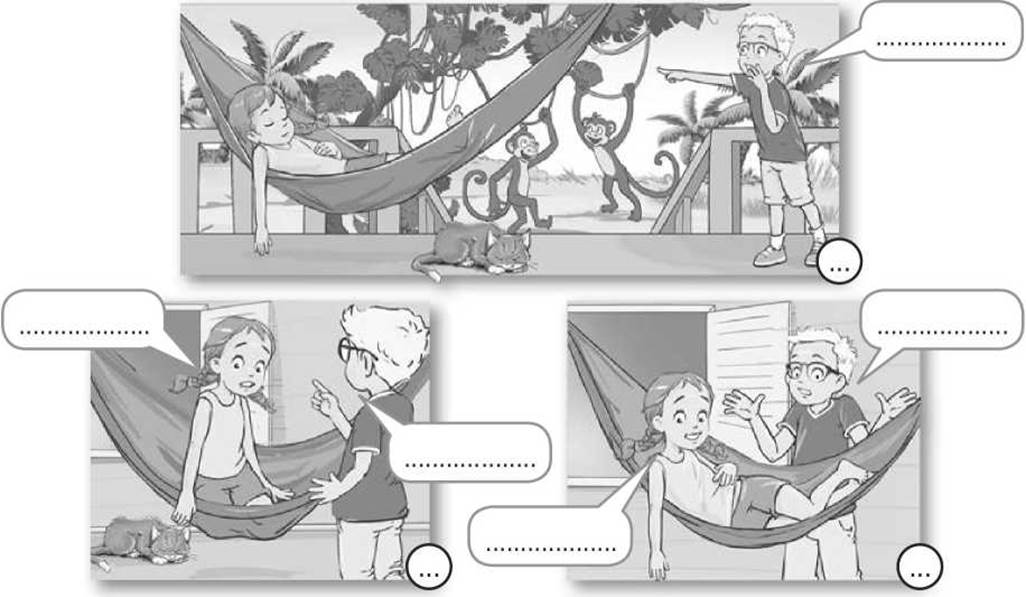
2 Provide them with a big comic picture, as in the example below.
3 Let them put the pictures into the correct order to make a story.
4 Let each group tell their story to the class.
You can also give your students some separate pictures and ask them to put those pictures into an order to make up a story. It will be more interesting if there are a few possible orders so that the students can use their imagination and their stories will be different.
6 Interviews
First of all, choose a certain topic. For example, «Seasons and Weather».
1 divide your students into pairs;
2 give each student a sheet of paper with questions:
a) which season do you like (winter, spring, summer, autumn)?
b) why?
c) what can you do in this weather?
3 let each student in the pair interview their partner as well as get interviewed by their partner, too.
4 in the end, let each student tell the class about his/her partner based on his/her answers to the questions.
7 Game «Find Your Partner»
1 write names of different celebrities on cards (singers, actors, dancers, etc) - each name should be written on two cards;
2 give each student a card;
3 students should find their ’twins’ by asking each other questions, e.g. «Is it a singer?», «Is it a man/woman?», «Where is he/she from?», «In which film does he/she play?», «Which song does he/she sing?», «Has he/she got long hair?» and so on.
(suggested by Phillips, 2017)
8 Game «Which One Is It?»
1 stick some pictures to the board;
2 put students into pairs;
3 each student should describe one picture from the board and his/her partner should guess which picture it is.
(suggested by Phillips, 2017)
9 Show and Tell
Each student shows a photo of his/her family, room, holiday, etc (depending on the topic of the lesson) and tells the class about them. Other students may ask the presenting student some questions about the people/ things shown in the photo in the end.
10 Songs and Rhymes
These are good to practise not only listening but also speaking. You can mime and gesture to them which makes the atmosphere in the class more fun.
A. Song «Old McDonald Had a Farm»:
«Old McDonald had a farm.
E-I-E-I-O!
And on his farm he had some dogs.
E-I-E-I-O!
Woof-woof here and woof-woof there,
Woof here, woof there and everywhere.
Old McDonald had a farm.
E-I-E-I-O!
And on his farm he had some cats.
E-I-E-I-O!
Miaow-miaow here and miaow-miaow there,
Miaow here, miaow there and everywhere.
Old McDonald had a farm.
E-I-E-I-O!"
Continue the song with other animals and the sounds which they make. For example, cows - «moo-moo», chicks - «cluck-cluck», pigs - «oink- oink» and so on.
B. Song «The Wheels on the Bus»:
«The wheels on the bus
go round, round, round,
round, round, round,
and round, round, round.
The wheels on the bus
go round and round,
all through the town.
The wipers on the bus
go swish, swish, swish,
swish, swish, swish,
and swish, swish, swish.
The wipers on the bus
go swish, swish, swish,
all through the town.
The horn on the bus
goes beep, beep, beep!
Beep, beep, beep!
And beep, beep, beep!
The horn on the bus
goes beep, beep, beep,
all through the town.»
C. Rhyme «One, Two, Three»:
«One, two, three, four, five.
Once I caught a fish alive.
Six, seven, eight, nine, ten.
I let it go again.
Why did I let it go?
Because it bit my finger so.
Which finger did it bite?
This little finger on my right!»
D. Rhyme: «Little Miss Muffet»:
«Little Miss Muffet
sat on a taffeta,
eating her curds and whey.
Along came a spider
who sat down beside her
and scared Miss Muffet away!»
11 Tongue Twisters
These are good to practise different sounds in English:
1 «Whether the weather is warm, whether the weather is hot, we have to put up with the weather, whether we like it or not.» - Sounds /w/ and /δ/.
2 «A big black bug bit a big black bear on his big black nose.»- Sound /b/.
3 «Six silly sheep still sleep.»- Sounds /s/, /ɪ/ and /і:/.
4 «How much wood would a woodchuck chuck if a woodchuck could chuck wood?»- Sounds /tʃ/, /ʊ/ and /w/.
5 «Peter Piper picked a peck of pickled peppers. Where’s the peck of pickled peppers Peter Piper picked?»- Sound /р/.
6 «I scream, you scream, we all scream for ice cream.» - Sounds /s/ and /і:/.
7 «He threw three free throws.» - Sounds /і:/, /θ/ and /əʊ/.
8 «She sells seashells on the seashore.»- sounds /і:/, /s/, /ʃ/.
9 «Three thin thieves thought a thousand thoughts. Now if three thin thieves thought a thousand thoughts, how many thoughts did each thief think?’’- Sound /θ/.
10 «Reading alone really allows you to relax.» - Sound /r/.
11 «I saw a kitten eating chicken in the kitchen.»- Sounds /k/ and /ɪ/.
12 «The first thing they think of is this.» - Sounds /δ/ and /θ/.
13 «Is this the thing? - Yes, this is the thing.» - Sounds /δ/, /θ/ and /ɪ/.
14 «I slit the sheet, the sheet I slit and on the slitted sheet I sit.» - Sounds /ɪ/, /i:/, /s/ and /ʃ/.
15 «Red lorries ride alongside the left road.» - Sounds /r/ and /I/.
16 «Larry likes to lick lollipops when looking at Lilly. »- Sound /I/.
17 «He has a hat in his hand.»- Sounds /h/ and /æ/.
18 «I went away to Venice and was very wary.»- Sounds /w/ and /v/.
19 «Meg met Ted, Ted met Meg.» - Sound /е/.
20 «Cars can’t be parked here after dark.» - Sound /a:/.
12 Drilling
This is one of the easiest but at the same time useful pronunciation activities that helps your students to learn the rhythm and intonation of the English language.
The teacher says a sentence in English (picks it up from a book or makes one him/herself) or uses an audio with a speaker who says that sentence. The teacher repeats it (or turns on the recording) several times. The students repeat after him/her a few times. This can be done in chorus or, if the group is not very big, each student in turn can do it separately 2-3 times. For example:
Teacher/Recording: «That is so nice!» /δæt ɪz ´səʊ naɪs/ (pronunciation), «THAT is SO nice» (intonation).
Student(s): «That is so nice!» / δæt ɪz ´səʊ naɪs / (pronunciation), «THAT is SO nice» (intonation).
13 Activity «Different Emotions»
This is another activity which is aimed at practising intonation in sentences:
1 write 2-3 short sentences on the board;
2 let students in turn read one and the same sentence with different emotions, thus using different kinds of intonation.
For example:
«It’s raining!» (sadly)
«It’s raining!» (happily)
«It’s raining!» (surprised)
14 Minimal Pairs
In English there are many words that are different in spelling and meaning but very similar in pronunciation (1-2 sounds difference). In speaking we do not spell words that is why it is necessary to pronounce everything correctly, otherwise, if there are very many mistakes, the person who is speaking will be misunderstood or not understood at all.
1 choose the two sounds which you want your students to practise;
2 write a few words with those sounds in two columns (underline the letter(s) that represent those sounds);
3 let your students see the difference in spelling;
4 pronounce those words yourself in contrast (one pair at a time);
5 let your students repeat after you several times.
6 point to the words and let your students read them themselves (first in chorus, then one by one).
For example:
Teacher: «It - eat.»
Student(s): «It-eat.»
Teacher: Hit-heat.»
Student(s): «Hit - heat.»
And so on.
|
/ɪ/ |
/і:/ |
|
it |
eat |
|
hit |
heat |
|
sit |
seat |
|
bit |
beat |
15 Total Physical Response
Since children like movement very much, this activity will suit them very well:
1 choose 2-3 sounds you want to practise;
2 prepare some cards with words that have those sounds;
3 write those 2-3 sounds on the board for the students to see;
4 say a few words that have those sounds as examples;
5 present each sound with a separate movement (for example, /æ/ - clap your hands, /ʌ/ - jump);
6 show your students the words on the cards (one by one);
7 students should make the appropriate movement according to the sound and read the word on the card.
16 Odd One Out
1 choose 2-3 sounds you want to practise, say them and then write them on the board;
2 make a few lists of words which have the same sound and one that does not;
3 let the students choose which word sounds differently than the others in each list;
4 students should read the words on the list and say which word is ’odd’.
For example:
Sounds /δ/ and /θ/
Think, that, those.
Thanks, throw, then.
Them, thing, the.
Thirty, thirsty, this.
You can write those lists on the board, show them on a computer or give each student a sheet with those lists individually.