Нова українська школа: методика навчання англійської мови у 3-4 класах закладів загальної середньої освіти на засадах компетентнісного підходу - Крістіна Карпюк 2020
7. Teaching Vocabulary
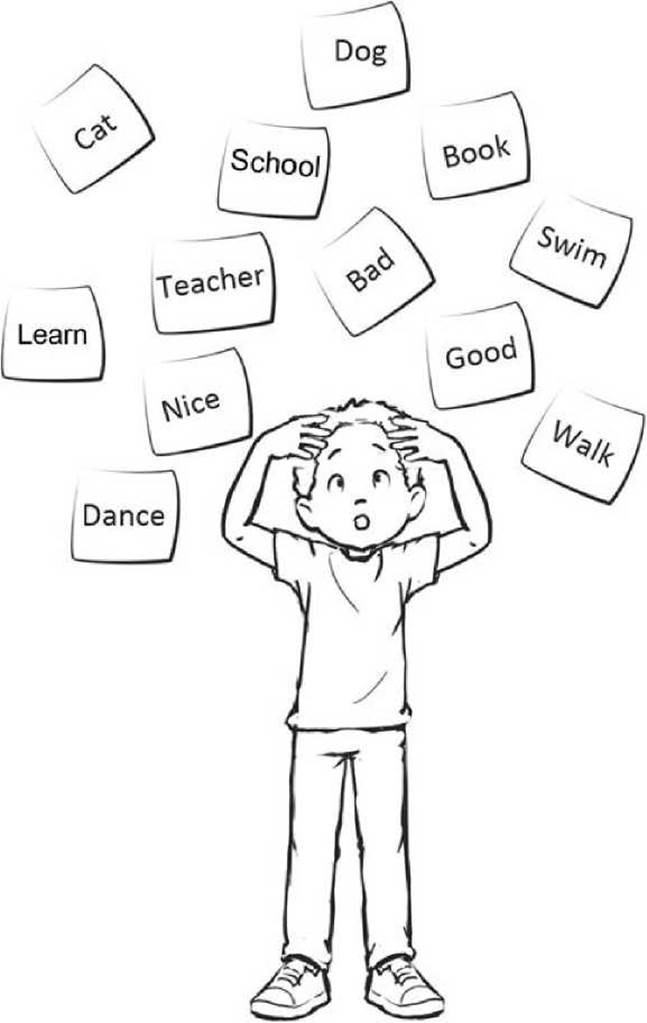
An essential part of any language is its vocabulary - words which are single distinct elements of speech that carry certain meanings.
Teaching vocabulary usually takes place when the lesson itself is lexisbased, when there is a need to explain some words before doing a certain task, like reading text, or when the teacher him/herself is asked by the pupil(s) about the meaning of a certain word.
As interesting as it sounds, teaching as well as learning new lexis can turn out to be a challenge.
First of all, in English, one word can have more than one meaning. Thus, translation does not always help. Very often everything depends on the context. For example, I’m going to the chemist’s to get some tablets; and My favourite tablets are iPads. In the first sentence the word tablets means a type of medicine, pills; whereas in the other one it is an electronic gadget.
Secondly, some words have connotations, that is, «the meaning can be interpreted in different ways, e.g. slim/thin/skinny» (Riddell, 2015).
In addition, the pupil may comprehend what the word itself means but not the context where it should be used, especially when it comes to formal and informal speech.
Other difficulties in teaching/learning vocabulary include the problem of one sound being spelt in more than one way (/к/ - key, call), one word being more than one part of speech (a break - to break), some words sound the same but have a different spelling and meaning (/еə/ - bare, bear).
So, what is the solution to all this? Firstly - patience. Some students may learn new vocabulary faster than others but that does not mean leaving the ’slower’ students behind. Instead, provide everyone with as much practice as possible. If your learners ’meet’ the new lexis only when you are introducing it for the first time, they will obviously have forgotten it by the time you summarise the whole chapter/semester. Otherwise speaking, make sure that the lexis is used over and over again, just like grammar. Let them hear it when doing different listening tasks so that they would remember the pronunciation. Let them see it in different texts when doing reading so that they would remember the spelling. Finally, let them use it in their own speech and writing so that they would remember it even better. It is also a good idea to combine it with the already-known words. However, do not overload your students, or else everything will get mixed up and they will get confused.
Another challenge in teaching/learning vocabulary is explanation. A lot of teachers use translation since it is the fastest and easiest way to interpret everything. However, it is not the best way to do it, taking into account the reasons showed earlier in this chapter. Moreover, it is even harmful, just like it is when explaining grammar.
American neurologists Karl H.S. Kim, Norman R. Relkin, Kyoung-Min Lee and Joy Hirsch discovered in their research, the results of which were published in the magazine Nature in 1997, that a person who speaks two languages fluently has distinct speech centres for each of those languages. The bilinguals participating in this research were people who were fluent speakers of both English and Spanish. It was shown and proven that the separate existence of the English speech centre from the Spanish one provided them with the capacity to speak both of these languages fluently. So, what promotes and what interferes with the development of these centres? It was explored and confirmed that when students apply their first language in learning a foreign one, the words and grammatical elements of the target (in this case English) language are added to the centre of the first one (in this case Ukrainian/ Russian). Thus, the separate speech centre of the foreign language is not formed. Instead, the target vocabulary and grammar just become an addition to the mother tongue. As a consequence, such students are good at translation and grammar explanation but are unable to apply that knowledge in real-life communication. A bright example is the Chinese pupils who study English at public schools, using the grammar-translation method. The result is visible: they are well-aware of the theoretical part of this language but have a lot of trouble in its practice when it comes to actual speaking.
In other words, there should be no Ukrainian/Russian either heard or seen during English lessons if our goal is to make our pupils great and fluent users of English. In place of it, we should create a natural English language environment in our classes, using the flexibility of our primary students’ brains discussed in the previous chapter.
Another question is: how can we create that environment? Especially when it comes to teaching new vocabulary? Since our learners are at the primary level only, their speech stock is not big enough to use definitions.
Truth to be told, there are many other numerous ways to introduce and explain new lexis, without the use of the first language or definitions. For instance:
✵ by using pictures and drawings;
✵ by showing real objects (’a pen’- show a real pen);
✵ by using mimics and gestures;
✵ by giving some synonyms.
In addition, some words can also be understood from the context, when reading a small text, for instance.
Applying the methods presented above provides the pupils with an opportunity to make some associations with the new lexis and this helps them to remember it better. Additionally, it is important for students to see and use that lexis in different contexts because it does help them not only with understanding it, but with remembering it, too. Harmer (2012: 84) also points out that «the trick of explaining meaning effectively is to choose the best method to fit the meaning that needs to be explained».
Apart from the exercises presented in the coursebook, it is always a good idea to use some additional materials from time to time. That way the lessons become less predictable which makes them more fun and interesting for the students. There are some good games and activities for teaching vocabulary to young learners in the end of this book.
SUMMARY
Vocabulary is a huge part of any language, including English. However, teaching as well as learning it is often a challenging process, since this language possesses its own characteristics and difficulties. Other things that need to be taken into account are the individual peculiarities of the students who we are learning it. Since these learners are children, we need to remember about the flexibility of their young brains which gives them the ability to grasp the meaning, the creative use of limited language resources and the capacity for indirect learning. They also have instincts for play and fun, rich imagination and instincts for interaction and talk (Halliwell, 2004). These children’s abilities provide teachers with the opportunity to avoid translation and create a natural English environment in class in order to make their primary students fluent users of English.