Нова українська школа: методика навчання англійської мови у 3-4 класах закладів загальної середньої освіти на засадах компетентнісного підходу - Крістіна Карпюк 2020
5.1. Listening
5. Language Skills
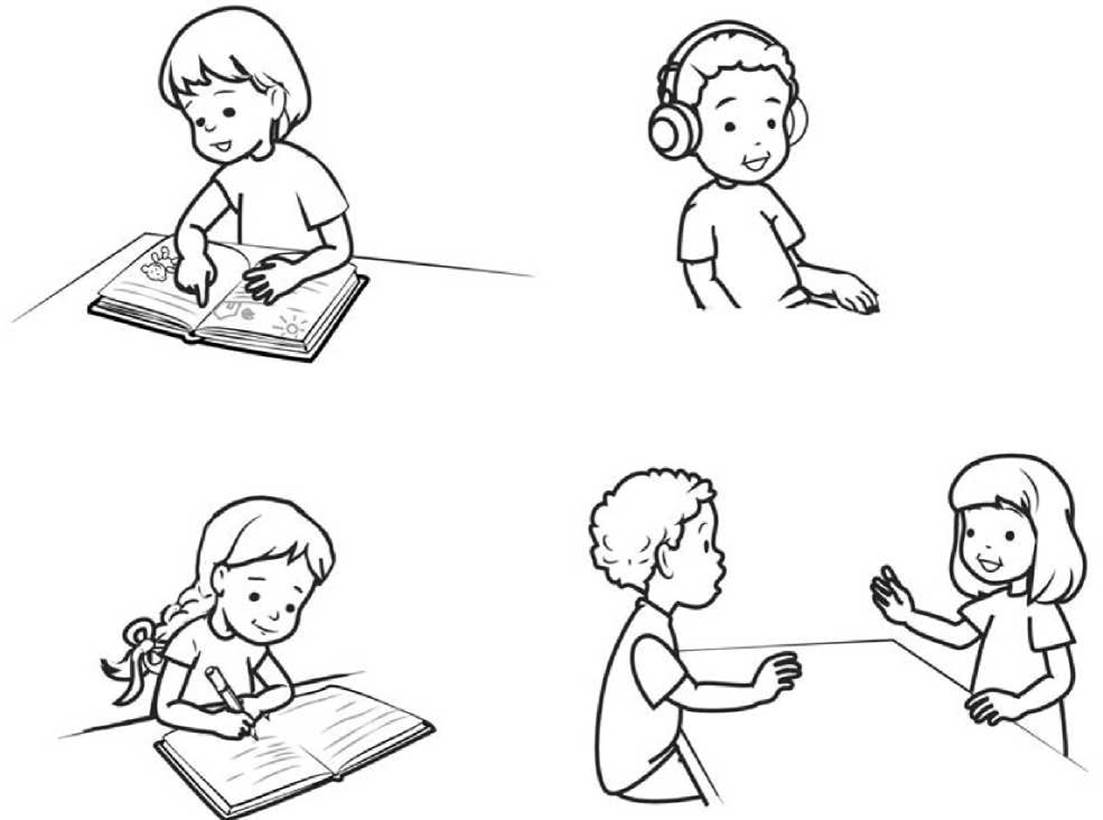
Skills relate to different aspects of language use. They are divided into receptive skills - listening and reading - «...where meaning is extracted from the discourse» and productive skills - speaking and writing - where language is actually produced. What is rather interesting about them is that they «...feed off each other in a number of ways» (Harmer, 2015: 297-298). Otherwise speaking, what we see and hear has a big influence on what we say and write. Every child begins his/her language learning from listening and then represents the data in speaking. After that he/she learns how to read and express everything in writing. This is an effective natural language learning process which works when the child is learning his/her mother tongue and it can work just as well in learning a foreign language. Thus, this chapter will describe each language skill in the following way: listening, speaking, reading and writing.
5.1. Listening
Listening means apperceiving the information by ear. This receptive language skill plays a significant role in communication because without it people are unable to participate in conversations, watch films and listen to the radio, attend presentations, lessons and lectures, etc. There are a few types of listening:
top-down listening - students try to understand the recorded text in general before looking after any specific data required by the task;
bottom-up listening - students are supposed to find the specific data right away.
On the other hand, listening can be intensive (as a rule, happens during the lesson, students are expected to seek for certain data and do some tasks afterwards) and extensive (usually happens outside the classroom, does not involve any specific tasks, in other words - listening for pleasure).
In addition, listening can be recorded as well as live. The first variant gives the students an opportunity to hear more different voices, it is usually specially designed for students at a particular level, it can be repeated and the teacher can have its script. However, there are some disadvantages, as well. For example, since it is usually designed for students, it is often unnatural; pupils are unable to interact with the speaker or to see him/ her (unless it is a video); since one audio track is used for all the learners, its speed is not always suitable for everyone; if the classroom’s acoustics are poor, not all students can hear the recording well. As for the second variant, live listening, it usually appears when pupils have conversations, do interviews, read aloud or during storytelling. Live listening provides them with an opportunity to practise this skill in face-to-face interactions, hear and use various formulaic expressions and intonations, repeat the data if it is unclear and, above all, see who they are listening to and respond to all kinds of paralinguistic and prosodic clues. On the other hand, if learners only do live listening, they get used to only their teacher’s and classmates’ voices and speeds which means it will be difficult for them to understand other people’s speaking.
Many students find this skill hard to develop in a foreign language because during listening activities they are usually expected to find some certain pieces of information instead of getting a general idea about it. Another problem is when the data on the recording is too hard to understand which is why it is so important for the teacher to choose the appropriate material for his/her young learners. As it was stated earlier, when the students only hear their teacher or classmates, they are not used to other voices and accents. This does not mean that they should not listen to them at all. In fact, there is a point of view that unlike the recording, the teacher can adjust his/her speaking and make pauses where necessary for students to understand the data better (this is especially useful for primary pupils whose English skills are not very high yet). Consequently, it is a good idea to use all ’sources’ in turn (teacher’s talk, students’ talk, recordings). Last but certainly not least, not all primary students are attentive. Since they are all children, their attention is scattered and they get bored rather quickly. That is why the material chosen for them to listen should not be very long and should match their interests. The tasks should also be various and challenging. We can present them in the form of a game, instead of just a test. For example, after checking the children’s understanding, we may ask them to look at the script of the recording and, if it is a dialogue, act it out. If it is a story/monologue, they can create their own continuation in pairs/groups. Some examples of listening activities will be shown later in this book.
In general, our task as educators is not only to help pupils practise their listening but also to help them overcome the difficulties which they usually face during it. There are some helpful strategies that we can give to our students in this case:
✵ think about the subject of the listening and activate the already-known data about it before doing the task;
✵ if this listening activity includes a dialogue, think what people might say in such a situation;
✵ predict the lexis which is likely to appear and think of some key words.
As for the teacher, it is important to:
✵ make sure your computer (or any other machine) works well and that you have the right file (or CD);
✵ include your pupils’ age, level and interests when choosing a recording and a listening task;
✵ reassure your students - tell them not to worry because the recording will be played twice if it is hard, there is no need in understanding completely everything, etc;
✵ apart from using your own voice, let your students sometimes hear different people with different accents and speeds;
✵ give the task to your students before doing the listening;
✵ if the recording is long or includes difficult vocabulary, divide it into a few smaller parts;
✵ play the recording twice;
✵ have a copy of the audio script in case there are any unclear points on the recording.
After some time and regular practice, your students become fluent listeners. In other words, they are able to listen to and understand longer and harder texts in English which is one of the teacher’s goals and results of his/her hard work.