Нова українська школа: методика навчання англійської мови в 1-2 класах закладів заглобальної середньої освіти на засадах компетентнісного підходу - Карпюк О. Д. 2020
5.2. Reading and Writing
5. Teaching and Developing Skills
Part I. From Theory to Practice
Reading and writing are closely related, since the more children read, the better writers they are likely to become.
Although children may learn to click on a computer mouse before they learn to turn the pages of a book, reading is a vital skill, because many children are growing up in an increasingly print-dominated world. Reading competence in English is essential to pass exams and to succeed at secondary school and after it. Through learning to read in English, children develop positive attitudes, strong motivation and a sense of achievement. Reading also reinforces and extends what children learn orally. Reading in English provides an opportunity to build on and transfer skills from and to their own language.
Reading is a receptive activity. For older learners reading is a required skill of its own and also a means of acquiring language.
What is involved in reading
Reading competence involves constructing meaning and making sense of written text. It requires complex interaction of knowledge and skills at multiple levels. These include, for example, the recognition of shapes of letters of the alphabet, grapho-phonemic correspondences and the direction of text. They also include sight recognition of common, high frequency vocabulary and morphemes, the recognition of syntactic patterns and word order within sentences, and an understanding of the structure and organisation of texts. When children read in English, they need to learn to make use of visual, phonological and semantic cues in an integrated way and to relate these to their previous knowledge and experience of the world, the topic and the genre in order to construct coherent personal meaning. To become competent readers in English, children need practice in developing their knowledge and skills in all these areas.
For this age group we are still giving the children the basic tools to start reading so it is not yet an input activity for them, i.e. it is not a way for children to acquire language. In order to start reading, the children need to learn to decode the word and link it to a meaning. The first step is knowing the letters. The objective is for the children to practise letter sounds and shapes in upper and lower case. For the children to start reading a word they need to practise each letter and immediately link it to the sound. This requires practice; we need the children to be completely familiar with letter sounds before asking them to try to read a word.
Pronunciation and early literacy
Teachers should provide a great opportunity to expose children to the varied sounds of English. It is important to develop phonological awareness, encouraging young learners to hear the qualities of different sounds and to practise the phonemes of the English language. These should be followed by activities which practise stress and intonation patterns: dialogues, stories, songs, chants and many games as well.
Pronunciation and literacy are closely related, since phonological awareness is a major factor in learning to read and write in an alphabetic language such as English. The letters in the English alphabet can be pronounced in a number of ways, however, at this level we should help young learners to become familiar with the most common pronunciations of English letters, since recognising letter-sound relationships is an important step in learning to read and write.
It is important that children get used to saying the most common phonemes for the letters of the alphabet, rather than their letter names. This is to enable them to sound out the letters and blend sounds in order to read some words straight away. Learning these relationships helps children to remember and pronounce phonemes and combinations of phonemes which don’t occur in their own language. Phonics also helps children develop their ’edging’ skill — the ability to hear where one word ends and another begins.
How to approach teaching reading
As a start, it is a good idea to ensure that the children’s classroom is a literate, print-rich environment in English. This can include, for example, labelling classroom furniture, creating a weather and date chart, making a birthday calendar and making a chart of key instructions, e.g. Listen, Read, Draw, with symbols to show what they mean. It can also include a display of pictures of famous people, story or course book characters with speech bubbles for key classroom language.
When we read, we activate two types of knowledge: what we know about making meaning (top-down processing) and what we know about language (bottom-up processing). With reading instruction, there is an ongoing debate about where to begin: should we focus first on helping children see the relationship between sounds and letters, beginning with decoding letters and words, and then move to larger units to focus on meaning (the approach used in phonics instruction)? Or should we begin with context and meaning, and then move to analysing and interpreting smaller segments of the language (the approach used in the whole language)? Clearly we need to do both.
When we are reading to children, we usually begin with context and meaning, relating what we read to the children’s lives and knowledge. From there, we may explain particular words, have fun pronouncing some of them (for example, rhymes or animal sounds), and attend to the smaller units of a text. But we don’t want to neglect practice in letter and word recognition. They play an important role in comprehending a text. Children need to understand sound-letter correlations (that the initial sound of dog and doll is the same and is represented by the letter «d,» and that other words that begin with that letter, such as desk, are pronounced with the same initial sound), so that when they encounter another word that begins with that same letter they can decode it. But this is only useful if they know what a dog, or a doll, or a desk is. If children do not know how to decode and have not learned the regular sound-symbol correspondences in English, when confronted with a new word, they are likely to skip over it, and doing that many times renders a text meaningless. The solution is to include phonics, discussed below, but to do it in a meaningful context (not using nonsense words nor focusing on words out of context). Ideally, in any unit, students will have opportunities to practise using both bottom-up and top-down processing skills, in a balanced approach to reading.
As Cameron (2001: 151) explains, children need to develop both top-down and bottom-up processing: «The child who picks up a set of words that she recognises as whole words and uses this sight vocabulary to read a simple text needs also to develop knowledge of grapho-phonemic relationships with words to progress to more difficult texts. On the other hand, the child who has learnt the names and sounds of the letters and can read simple, regular words by ’sounding them out’ needs also to recognise morphemes by sight and to draw on grammatical information at sentence level if progression is to be made.» Asher (1998) also believes that differences in learning styles make it important to incorporate both approaches: auditory learners will find phonics more appropriate, while visual learners will prefer the whole word or look-say approach.
In balancing methods of teaching reading, at least the following two approaches should be considered for young learners:
✵ Phonics
✵ Whole language
PHONICS
Phonics is a bottom-up approach to processing a text. It focuses on the smallest unit of the text: the letters. It teaches children the relationships between sounds and letters, how a particular sound is symbolised in print, and how to «sound out» a word, given those sound-symbol relationships. It usually begins with individual sounds (such as /I/ or /s/ in initial position) or short words that rhyme or share a common sound (for example, cat, rat, hat or can, ran, man).
The goal is to help children decode written language, using the sound-symbol relationships they have learned, either in isolation or from other words. So, for example, when children see the word bat, they can recognise the letters of the alphabet and understand the way sounds are represented in writing. They can also refer back to words they have learned that are written with similar patterns. In this way they can be successful at decoding, since that is key to early reading success (Beck, 2006).
Phonemic awareness activities
Before focusing on letter-sound relationships through phonics, children need practice in discriminating English sounds what is referred to as phonemic awareness. This involves, for example, separating the spoken word big into three distinct phonemes, /b/, /і/, and /g/. Phonemic awareness training helps children to understand the rules of English and, overtime, helps build reading fluency.
The following are some activities to help young learners to become aware of English phonemes. Learners should listen and:
► identify the first sound in a word (/b/ in boy)
► identify the last sound in a word (/t/ in kite)
► identify the common sound in a series of words (/i:/ in see, me, tree)
► identify the word that doesn’t rhyme (dog, fog, leg)
► change one sound for another in the beginning (cat to hat), middle (cat to cut), and end of words (cat to can) to create new words
► blend separate sounds into a word
► delete a sound (sat to at)
► blend initial consonant clusters (/st/ in stop)
► identify final consonant blends (/st/ in first)
Phonemic awareness activities can be fun. There are some examples below.
► Going on a Rhyme Hunt: looking for objects in the class that rhyme.
► Playing Match Mates: giving picture cards to each child and then having the children find a picture that begins or ends with the same sound or rhymes with the word they have.
► Playing Odd Man Out: posting pictures of objects that begin or end with the same sound or have the same medial sound, as well as some that do not. Children find the pictures of things that don’t share a sound. This can be done in pairs or small groups.
► Playing Bouncing Ball: toss a ball to a student after saying a definite word. The student has to think of a word that begins with the same sound. When students can think of no new words, begin another sequence with another. This can also be done with words that end with the same sound or rhyme.
► Playing Rhyming Words Walkabout: arrange students in a circle. Have them to listen for rhyming words. When they hear two words that rhyme, they take one step forward. When they hear two that do not rhyme, they step back or stand at the same place (Adapted from Kauffman, 2007).
Phonics activities
Phonics activities can also be fun. Some of the activities used for phonemic awareness can be adapted for phonics by including the written word.
For example:
► Odd Man Out could be played with a set of picture cards with words written on them. Children find the word that does not belong because of a difference in the initial, medial, or final sound.
Other engaging activities include:
► Singing or chanting familiar songs, chants, or rhymes while you point to words in the song or chant displayed on chart paper, the board, or from a flashcard. Afterwards, have children come to the board and point to rhyming words or create new verses with new rhyming words.
► Creating fill-in-the-blank activities with clues:
The horse lives on a ___________ _____. (farm)
I _arm
► Playing Ваg-It: matching letter or word cards with pictures displayed in the class. One way to make this fun is to write the letters for a picture on the outside of a small paper bag. Children find the picture that matches the letters and put the picture in the bag. (Note that this also keeps the activity manageable, as the pictures are then stored in their appropriate bag.)
► Playing Hang-Up: hang a picture card on a clothes hanger with a clothespin. Students have to find a letter that matches the picture (such as the initial sound) and hang it on the same clothes hanger, but facing the other way. Display these in the class.
Young learners will benefit from systematic, explicit instruction in sound-symbol correspondences in English. However, to be meaningful, phonics instruction should focus on words that children have already learned orally within a meaningful context, not in isolation. Otherwise, children may get the idea that reading is «sounding out» words, even if they don’t understand their meaning. The same is true of the names of the letters. Teach them as they fit into the context and content of the lesson.
WHOLE LANGUAGE
A whole language approach begins with meaning and then uses language in context for further word or language study. It involves top-down processing, in which children bring their knowledge of the world, their experiences with oral language and texts, and their knowledge of the written language to constructing comprehension of written texts, using four types of clues:
✵ Grapho-phonemic clues: referring to expected sound-symbol correspondences
✵ Semantic clues: referring to what word(s) would be expected, based on the meaning
✵ Syntactic clues: referring to the part of speech that would be expected in a given place in the sentence
In early literacy, the whole language approach might begin with a focus on common words (sight words) that the children have already heard and said, perhaps in a story or song or even in popular media, in what is often referred to as a sight-word or look-say approach.
Sight words are taught because they are meaningful to the children and can then be used in a variety of activities. The words and chunks (collocations such as have fun, take a bath, or catch a ball) can be written on individual flashcards and then matched with pictures, objects, actions, or held up and used with repeating refrains or songs. They may be posted alphabetically on a word wall, where they can be called upon to help with reading in writing. Learning sight vocabulary helps children to see the connection between meaning and visual representation. Over time, children build up a large vocabulary of high frequency words.
Teachers using a whole language approach to reading may take their learners through the following sequence of reading activities which are complemented by a similar sequence of writing activities (to be discussed).
|
Stage of a Lesson |
Activity |
|
Presentation |
Reading aloud |
|
Controlled practice |
Shared reading |
|
Guided practice |
Guided reading |
|
Independent activity |
Independent reading |
While there are no definitive conclusions from research on how reading in a foreign language should be taught to children, by providing opportunities to develop skills at the letter, word, sentence and text level, creating frameworks for children to read for meaning in purposeful ways, modelling your own enthusiasm and the processes and strategies involved, encouraging personal, divergent responses, and raising reading awareness of genres and strategies, as and when appropriate, children will develop into increasingly competent readers by the end of primary school.
From reading to writing
Reading provides a scaffold for learning to write and it is frequently appropriate to teach reading and writing in an integrated way, both in the initial stages and when children have more developed skills.
Initial writing
In the initial stages of learning to write, young children need to develop hand-eye coordination and fine motor skills, and the effort and concentration which goes into forming letters and words is a challenge in itself.
Handwriting is a lifetime skill, so it is important to start from the beginning with correct hand movement habits that will lead on to writing a ’good hand’. The important role of handwriting in holistic development, and especially brain development, should not be disregarded. Neither should the support that handwriting contributes to consolidating early literacy skills. Although handwriting skills cannot be replaced by keyboard-writing activities on screen, these activities, if well chosen, can also complement holistic development and broaden learning.
Handwriting is a skill involving copying the Roman capital and small letters correctly and writing them legibly. Handwriting needs to be a tutored skill for young children if letters are to be formed in the correct way, enabling the handwriting to flow naturally onto cursive (joined-up) writing later on.
Handwriting follows on from learning to recognise letters and words, and most children can read written language before handwriting skills have been completely mastered.
Children learn soon to write in English, when presented with a structured programme of letter formation. This is because the basic concepts of what writing represents (encoding) have already been learned in Ukrainian (or other first language).
Secret languages and codes seem to fascinate young children and many seem interested in being able to write English, which they see as another type of ’cool’ code. To be able to write in English also provides written ’proof’ of progress for both children and parents. This visual and permanent sign of progression gives satisfaction that motivates. Establishing the correct routes and stroke orders in handwriting takes time and effort.
Many methodologists recommend to introduce handwriting with the small letters first, as most text we read consists mainly of small letters. Words written in small letters are easier to recognise than those written in capitals. Capitals are generally used to fill in forms, for emphasis in written text (for example, STOP!), or to attract attention to signs and notices. Apart from their own names, or initial capitals for sentence writing, children won’t really need to use capitals much in the early stages of writing. If children are taught to write capital letters first, they naturally write their first words all in capitals.
As soon as children can recognise the small Roman letters, they are ready to begin learning how to write them. Learning to handwrite is rather like an apprenticeship. The adult demonstrates while the child looks. The child then does it alone, while the adult encourages and guides. Demonstrations can include making the movement of the letter shape using the index or middle finger on the palm of the other hand or by writing in the sand. This type of tactile demonstration should be done before writing on paper with a soft-leaded pencil so that children get the ’feel’ of the movement made by the letter (for example, a backwards / anticlockwise circle, or a descending stroke — both of which may be new to children who write in a different script).
Teaching how to form the letters is important. Once children have learned how to make the letters ’the right way’, these movements become second nature. It is important to go slowly. More practice in the early stages makes the later stages easier, as there is less need for focused remedial handwriting.
’Practice makes perfect’, an old English proverb says. Meaningful opportunities to handwrite something each day or many times in a week develop the necessary muscular control and hand-eye coordination. Children can self-focus where to practise and they will self-assess their improvement. Any show of improvement is sufficient to self-motivate. It is through practice that the child develops the necessary movement skills. Not until the child has mastered the basic movements to make the letters does he or she begin, unconsciously, to insert his or her own creativity into handwriting.
Handwriting practice
Copying known text is an important, often misunderstood, step in learning to write. It enables the child to focus exclusively on improving handwriting skills, without the burden of having to decode or create text. Copying also helps to reinforce memorisation of how words are spelt.
Children often enjoy trying again and again to achieve a good piece of work. Teachers should ensure children are writing with the correct utensil (a soft pencil) and should allow children to rub out and self-correct letter shapes where they feel they can do better. Praise should be given for tenacity and effort!
Copying known text:
✵ is a basic step in holistic literacy development, providing focus on handwriting whilst giving broader experience in written language and spelling
✵ is useful reinforcement as children often recite the text to themselves word by word as they write
✵ enables a child to focus fully on his or her handwriting skills, since it involves only one task (copying)
✵ is useful for providing ’show-off’ pieces of work that record progress in both handwriting and reading the known text
✵ can be followed by children adding their own creative design, pattern or picture to complete the experience
Stimulating children to handwrite
Sometimes it is necessary to encourage a child’s desire to write, especially for boys who don’t like to sit still for too long. Teachers should remember that once interest in a writing activity begins to wane, it is time to move on to something else. The activity can be completed in the next lesson or, if reasonable, finished off at home.
Extending an activity to the point of loss of interest can be counterproductive and put children off writing. Below are some simple ideas for stimulating an interest in handwriting:
Writing letters to classmates
✵ The teacher makes a postbox for the classroom from cardboard boxes, with a slit for posting letters.
✵ Children handwrite a simple message or greeting to a classmate on illustrated or coloured paper. The paper is folded and the classmate’s name is written on the outside. The ’letter’ is then ’posted’ in the classroom postbox.
✵ Before home time, a class ’post person’ opens the postbox and delivers the letters. The teacher can add his or her own letters (with more advanced text) to ensure that all children receive a letter each week.
Copying known rhymes onto cards
Children choose a known rhyme to copy onto a card, decorate it with pictures and then display in the classroom.
Exhibiting work
Children learn much from each other’s work. In fact, often more is learned from other children’s ideas of presentation, design and layout than from explanations given by the teacher or parent. Work done at home or during the lesson should be displayed in the classroom. If possible, it is a good idea to keep children’s work over a period of a term or a year in a folder so that they and their parents can track the development in their writing skills.
The style of handwriting
Writing simple print versions of letters (without flicks) is easier to begin with. This is because simple, written print matches more closely the print they are learning to read (decode) and beginning to spell (encode). Once the children’s ability to recognise and match print and handwritten letters is more developed, the transfer to cursive handwriting is quick since muscular control and handeye coordination has already been built up via learning to write simple print.
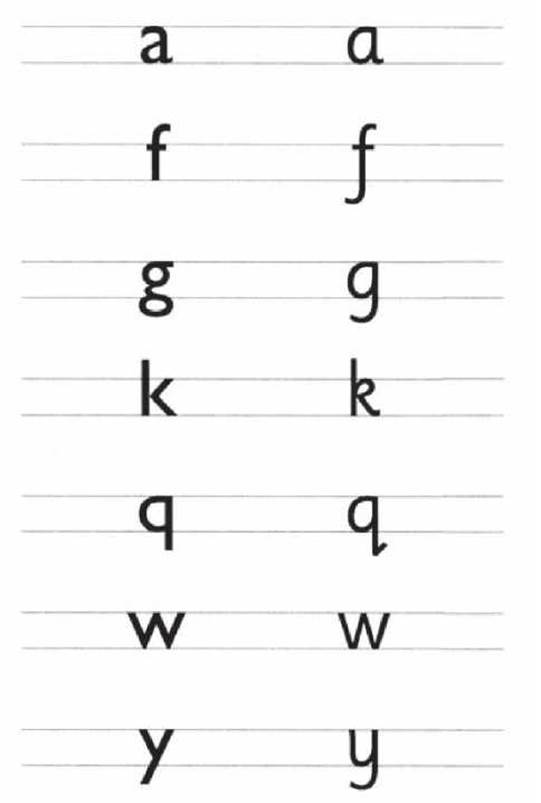
Ukrainian schoolchildren can benefit from learning to write with ’tracks’. Consisting of three or four guidelines, tracks can help children get used to the relative size and proportions of capital and small letters. The tracks guide children on the general size of letters, as well as on how high or low to go above or below the line when writing ascending and descending letters. It is helpful to provide paper with tracks (3 or 4 guideline tracks) for a short period.
Once young children have sufficient experience, the number of guide lines can be reduced to two and then just one (the ’base line’). As children become fluent handwriters, they will use only the base line to develop their own size of writing.
Teachers should remember that children want to use their knowledge of how to write letters to form words as soon as possible.
Introducing capital letters
As soon as children know sufficient small letters to write words which they know orally, they should be encouraged to do so. The capital letters can then be introduced into writing naturally at the beginning of personal names and for the personal pronoun T. As children get more advanced, capitals can be used in other situations, for example, at the beginning of sentences or for the names of towns, cities or countries.
Spelling
Through experience (especially reading aloud) some children appear to develop an innate instinct for how words look; they get a ’feel’ for whether the spelling looks right or not. Adults quite often write a word in two different ways to confirm which looks to be the correct spelling. Some children start to use this strategy themselves as they develop their innate ’feel’ for how words are spelt.
Visual recognition may be stimulated further by ’writing’ the shapes of words on the palm of the other hand using the two sensitive fingers (the index and middle finger). It is thought the more you write, the more remember, as memory is learned through the hand.
The Spelling Quizz
Regular spelling quizzes can be enjoyable if the approach is playful and the degree of difficulty is structured. Children enjoy listening to the ’music’ and rhythm of words spelt out loud.
Quizzes need to be playfully presented and carefully graded. It is important to start with easy quizzes so that children know they can get all or most of the items right. Having self-confidence is very important.
Young children need to repeat and repeat what appears to adults a pointless activity. It is important not to rush children and not to introduce them to too many of the complexities of English spelling until they have a solid basis, as well as a range of self-learning strategies with which to proceed with confidence.
Quiz content can include words, phrases or short sentences.
Spelling quiz management
► Hold a quiz regularly once a week at a set time. Give several days of preparation time.
► Make a spelling book for each child, sticking in each week’s printed list of words for reference.
► Model the word, phrase or short sentence, pronouncing clearly so children can hear the sounds.
► Allow children to self-correct, if possible, letting them keep secret from others how many they got right!
► Follow the same routine each time, leading up to sharing the ’teacher’s role’ with a child who dictates the spelling words.
► Where necessary, divide into groups to match learning abilities, taking care not to cause ’loss of face’. There can be surprises as some children can spell more easily than they can speak. Others can change their ability once they understand how to focus.
Recognising patterns of ’onset and rime’
In the initial stages of spelling in English, it is easier for young children to recognise patterns if words are divided simply into two clear sections: ’onset and rime’. Children have already initiated play with words with different onset and rime (for example, d/ot, m/at, sl/at, h/at, fl/at) when learning to read. This easy-to-understand method introduces an initial analysis of word patterns, which can lead on to more sophisticated encoding (synthetic phonics) as children become more mature and experienced users of English.
Onset
Onset consists of all the letters and phonemes (blends, diagraphs) before the first vowel: b/oat, tr/ain, pl/ay.
Rime
Rime continues from the first vowel to the end of the word. Through rime the patterns in words are clearly identified. Children can hear and see them more easily: t/able, st/able; p/air, st/air; b/oat, g/oat.
Children enjoy highlighting similar patterns in the same colour. This activity is more than simply colouring as it focuses learning strategies and increasing observation.
With practice, young children unconsciously constantly use analogies to match sounds to spelling patterns. Making analogies increases self-confidence as it shows progress and also gives them the feeling that they are in control of their learning.
Through spelling quizzes a structured scheme of known spelling patterns can be consolidated and, where necessary, revision can be introduced.
Teachers need to support children by:
✵ creating quick sessions to search, discover and widen their recognition of patterns
✵ providing groups of words with matching rimes but different onsets
✵ helping them find analogies
✵ explaining fun facts about words
✵ looking at the origins of words
✵ increasing vocabulary
Teachers should only include known words for new spellings. They can include words which:
✵ have matching rimes: small, fall, wall
✵ appear in simple phrases: a sunny day, a good way
✵ appear in short sentences: My red bag is there
How to use a ’look-cover-write-check’ spelling sheet
Teachers can ask children to follow these steps:
Look: Look at the word in your book. Write the word in the air or on the palm of your free hand with your index and middle finger.
Cover: Cover the word in your book. Close your eyes and see the word in your mind.
Write: Open your eyes and write the word with your pencil.
Check: Uncover the word in your book and check. Do the spellings match?
Repeat: Do it again.
Spelling Sheet

The emphasis in initial writing is to support and consolidate oral/aural work, through, for example, reinforcing the understanding and spelling of familiar vocabulary items and sentence patterns.
It is very important to encourage children in their writing, tracing, copying, and drawing. Do not worry if children are unable to trace, write, draw or colour neatly. These skills will emerge during their primary years.
As children progress, they can be introduced to writing short texts, which may either be based on a model.